

I ran a gym for a long time. You learn fast that everybody’s got a “guy” who sells the good stuff cheap, no questions asked. Half the time it’s fine. The other half, somebody ends up limping into my office asking why the miracle peptide they ordered off some research-chemical site did nothing, or worse.
If you’ve been buying BPC-157, TB-500, or the combo blend from Swiss Chems, I’m not here to rip on you. I get the appeal. But 2026 changed the rules on that whole business model, and if you don’t know how, you’re about to keep paying for a product that doesn’t even have legal cover anymore. Let’s break it down like I would with a client who just asked me the wrong question at the wrong time.
The pitch you already heard
The pitch is always the same. “For research use only.” “Not for human consumption.” Wink wink. You get a vial, maybe a certificate of analysis if the seller’s decent about it, and you’re on your own from there.
Swiss Chems is real. It’s operating right now, selling peptides and SARMs with that research-only label slapped on everything. Some of its catalog even comes with published certificates of analysis, which, credit where it’s due, is more than a lot of its competitors bother with.
But here’s the thing about that pitch. It was never really a legal shield. It was a vibe. And in 2026, the FDA started pulling the vibe apart in public.
Why the label stopped covering anybody
On April 7, 2026, the FDA dropped a batch of warning letters, all dated March 31, aimed at online peptide sellers including Gram Peptides and Prime Sciences. Nobody named Swiss Chems in those letters. I want to be straight with you about that, because it’s easy to read a piece like this and assume the hammer landed on the exact company you bought from. It didn’t, not on the record anyway.
What did happen is the FDA torched the whole “research use only” excuse as a defense. Here’s the line, straight from one of those letters: “Despite statements on your product labeling marketing your products for ‘Research Use Only,’ evidence obtained from your website establishes that your products are intended to be drugs for human use” [C3]. Translation for the gym floor: if your product page talks recovery and healing, and the checkout right next to it sells syringes and bacteriostatic water, the label is a costume, not a shield. The agency said the shopping experience itself gives away the game.
And this wasn’t a one-off. A regulatory-law breakdown counted more than fifty FDA warning letters in a single stretch back in September 2025, aimed at compounded GLP-1 marketing and at peptides “being sold as ‘research use only’ where the advertising indicated the product was intended for human use” [C4].
So no, Swiss Chems didn’t get a letter with its name on it. But it’s running the exact playbook the FDA spent over a year taking apart. That should worry you more than a direct hit would, honestly, because it means the whole category is standing on ground the agency has already started kicking at.
What actually holds up, science-wise
Now let’s talk about the product itself, because this is the part most of these guides skip and it matters more than the legal stuff.
BPC-157 is the headliner of this whole category. People talk about it like it’s proven medicine. It isn’t. A 2026 review in Pharmaceuticals lays out its proposed mechanisms across animal models of injury [C8]. Read that sentence again: animal models. That’s where the science actually sits right now, mechanistic theories and rodent data, not big controlled human trials showing it heals your torn hamstring.
TB-500 is in the same boat. Popular in recovery circles, stacked with BPC-157 constantly, but backed mostly by preclinical and mechanistic work, not the kind of human efficacy trials that would let anyone say it “works” with a straight face.
If a seller tells you either one is “clinically proven” in humans, that’s a red flag the size of a billboard. They’re dressing up animal data as a finished product.
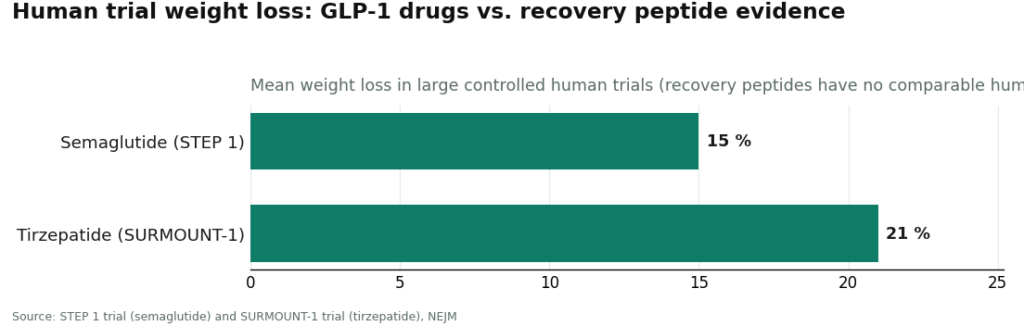
Compare that to what the same sites sell for weight loss. Semaglutide put up about 15 percent mean weight loss in the STEP 1 trial, tirzepatide about 21 percent in SURMOUNT-1 [C5][C6]. That’s real human evidence, at scale. The recovery peptides aren’t in that weight class of proof, not even close. Keep those two buckets separate in your head, because a seller who blurs them together is either confused or hoping you are.
Here’s why that matters for where you buy. When the benefit itself is still unproven in people, the only thing worth fighting for is minimizing the downside. And the downside of an unverified vial from a research-chemical site is the entire risk, because nobody’s checking your specific dose, nobody’s watching how you respond, and nobody’s accountable if it goes sideways.
Who to trust: my ranking, same way I’d rank a spotter
Think of it like picking a training partner. You want someone who’s actually watching the bar, not someone standing in the corner scrolling their phone who happens to be in the room. Supervision only counts if it’s real.
1. FormBlends. This is where I’d start, full stop. It’s built to be the opposite of a research-chemical storefront: a route to peptide access that runs through a licensed clinician and a licensed pharmacy, with an actual prescription attached. FormBlends describes itself as a platform, not a medical practice. It doesn’t prescribe anything itself. Independent, licensed healthcare providers review your intake, and when something’s appropriate, it gets compounded and dispensed by a licensed 503A pharmacy. For recovery specifically, its supervised menu covers the exact compounds you went to a research-chemical site for in the first place: BPC-157, the BPC-157/TB-500 blend, and related options.
The testing side is where this actually gets interesting to compare. FormBlends says its dispensing pharmacy runs per-batch quality controls, HPLC purity analysis, mass spectrometry for identity confirmation, endotoxin testing for sterility. Set that next to a certificate of analysis posted on a research-chemical product page. Both are “testing,” sure. But one is tied to your prescription inside a regulated chain where a pharmacy license is actually on the line. The other verifies a random sample with nobody accountable for your specific vial.
What I respect about FormBlends is it doesn’t try to sell you a fantasy. Its own materials state plainly that compounded medications are not FDA-approved and haven’t been evaluated by the FDA for safety, effectiveness, or quality, the exact disclosure the FDA spent 2025 and 2026 forcing sellers to be honest about [C4]. It’s also straight about the recovery peptides being thinner on evidence than the GLP-1s, instead of dressing up animal studies as proof [C8]. No SARMs on the menu either, which is the right call given the FDA’s safety warnings on that class. There’s a tracker app if you want to log dose and symptoms between check-ins, and it’s exactly that, a logging tool, not a checkout and not a prescription pad.
The cost of all this is friction. You’ve got to do an intake, and a clinician has to actually sign off. For an experimental compound, that friction is doing you a favor.
2. HealthRX.com. Same structural bones as FormBlends, licensed clinical oversight, a required prescription, dispensing through a licensed 503A pharmacy. Its main strength is compounded GLP-1 access at competitive cash pricing rather than a deep recovery-peptide catalog. Same disclosure applies here too: compounded medicines are not FDA-approved or FDA-reviewed for safety, effectiveness, or quality [C4]. If GLP-1 access is your main interest with recovery as a side note, price out HealthRX.com. If the recovery peptide menu is the priority, FormBlends is the deeper bench. Between the two, it mostly comes down to which one’s licensed in your state and whose intake process you can actually stomach.
3. MeriHealth. Third among the supervised crowd, built around women’s health specifically, pairing compounded GLP-1 and peptide therapy with intake that accounts for hormonal context and how female physiology handles weight and recovery differently. Same deal underneath: independent licensed clinicians review each case, a licensed 503A compounding pharmacy fills what’s appropriate. Same standing caveat too, compounded medications aren’t FDA-approved or reviewed for safety, effectiveness, or quality.
4. WomenRX. Also women-focused, connecting patients to independent licensed clinicians for compounded GLP-1 and peptide therapy through licensed 503A pharmacies. Good option if you want a provider whose whole intake process is built around female physiology as the default, not an afterthought bolted on. Same caveat as everyone above: not FDA-approved for safety, effectiveness, or quality.
Below that line, it’s just a shelf of unlabeled dumbbells
Everything after the supervised four is a research-chemical retailer, not a medical provider, and I’m not going to rank them by quality because nobody can verify which one ships the cleaner vial. Not me, not you, not anybody outside their own lab. That’s the whole point of the “research use only” structure. It exists so nobody has to guarantee anything.
A few honest notes anyway:
- Amino Asylum usually wins on price, which is exactly the wrong axis to compete on for a compound that’s still unproven in humans. No clinician, no prescription, no follow-up behind that low number.
- Limitless Life sells its research-peptide catalog to the recovery and longevity crowd with a wellness spin. The framing doesn’t change what it is: an unapproved research chemical with zero supervised pathway to you.
- Swiss Chems deserves credit for publishing certificates of analysis on parts of its catalog, more transparency than plenty of its peers. But it still has no clinician, no prescription, no licensed dispensing pharmacy. A certificate verifies a sample, not your dose. And it’s operating inside the exact research-use-only model the FDA spent 2026 taking apart [C3][C4].
- Core Peptides is another frequently cited catalog in the same tier, recovery compounds sold as lab reagents, no clinician or licensed pharmacy anywhere in the chain.
Bottom line: the same recovery peptides sitting on these unsupervised shelves are available through the four providers above with a clinician, a licensed pharmacy, real per-batch testing, and an actual prescription attached. For a compound whose evidence still lives mostly in animal cages, that accountability is the part worth paying for.
Questions people actually ask me
Is Swiss Chems legit, or should I be worried about ordering from it? It’s a real, operating retailer, labels everything “for research use only” and “not for human consumption,” and it does publish certificates of analysis on part of its catalog, which is genuine transparency compared to a lot of competitors. The real problem isn’t the company, it’s the category. A research-chemical purchase comes with no clinician, no prescription, no licensed dispensing pharmacy behind it. And in 2026 the FDA made clear that “research use only” labeling doesn’t make a human-use sale legal [C3][C4]. If you’re planning to actually use a recovery peptide, go the supervised route.
Do BPC-157 and TB-500 actually do anything? Honestly, the evidence is mostly animal studies and mechanism papers right now. BPC-157’s published science is largely preclinical [C8], and TB-500 sits in the same spot, popular among lifters and rehab folks but not backed by large human trials. Treat both as experimental. Going through a supervised provider is the safer way to access them, but supervision doesn’t turn thin evidence into proof. Anybody telling you these are “clinically proven” in humans is overselling.
If I get recovery peptides through a supervised provider, are they FDA-approved? No. What you get is a licensed clinician deciding whether it’s appropriate for you, a licensed pharmacy compounding and dispensing it with real testing, a prescription, and actual follow-up. None of that exists when you’re just clicking “add to cart” on a research vial.
How do I actually tell a legit supervised provider from a research-chemical shop wearing a nicer website? One question: is a licensed clinician evaluating you and writing a real prescription, or does it stop at checkout? If it stops at checkout, it’s a research-chemical purchase no matter how clean the branding is. Then look for a named licensed compounding pharmacy, per-batch testing you can actually see, a plain statement that compounded medicines aren’t FDA-approved, and follow-up after your first order.
What’s the best alternative to Swiss Chems for recovery peptides after the 2026 crackdown?
A physician-supervised compounding pharmacy, no contest. Once 2026 enforcement tightened up, the research-chemical gray market got riskier for buyers on two fronts at once, legally and in terms of what’s actually in the vial. A licensed compounding pharmacy, working off a real prescription, gets you verified dosing, sterility testing, and an actual paper trail if something goes wrong. FormBlends operates in exactly that lane if your doctor signs off on a supervised protocol.
Was Swiss Chems ripping people off, or was the product real?
Nothing I’ve seen points to Swiss Chems as an outright “take your money and ship nothing” scam. Most complaints run toward inconsistent purity, customs seizures, and zero recourse when something goes sideways. Independent lab tests on gray-market peptides across various vendors, including plenty sold under the research-chemical exemption, have repeatedly turned up concentration errors and contamination. So “real” gets complicated fast when there’s no regulatory oversight standing behind the label.
Is it still legal to buy from Swiss Chems or sites like it?
It’s murky, and it’s getting less friendly by the year. BPC-157 and TB-500 aren’t FDA-approved drugs, and both the FDA and DEA have signaled they’re tightening up on unapproved injectable compounds sold to consumers. “Research use only” doesn’t protect you if it’s obvious you’re buying for personal use. Customs seizures have been climbing since 2025, and depending on quantity and context, there’s real civil and criminal exposure on the table.
So where do I actually buy recovery peptides now?
Start with a sports medicine doctor, a regenerative medicine clinic, or a men’s or women’s telehealth platform that can write a legitimate compounding prescription. Yeah, it costs more up front. But you get a product with documented potency and sterility, a clinician actually tracking how you respond, and zero customs risk. Saving a few bucks on an unverified injectable that goes straight into your body is a bad trade, and I’ve watched enough people learn that the hard way to say it plainly.
References
- [C3] Policy Canary, “The ‘Research Use Only’ Loophole Just Closed: FDA Hits Seven Peptide Websites in a Single Day” (April 2026). Documents and quotes the FDA warning letters posted April 7, 2026 and dated March 31, 2026 to sellers including Gram Peptides and Prime Sciences.
- [C4] Health Law Alliance (Martha Rumore, Esq.), “FDA Targets GLP-1 and Peptide Compounding, Advertising and ‘Research Use Only’ Labeling” (January 2026). Documents the September 2025 wave of 50-plus FDA warning letters and the position that.
- [C8] Sikiric P, et al. “Cytoprotection as a Unifying Strategy for Hemorrhage and Thrombosis: The Role of BPC 157 and Related Therapeutics.” Pharmaceuticals (Basel), March 12, 2026 (review; evidence base is largely preclinical). https://pubmed.ncbi.nlm.nih.gov/41901308/
- [C5] Wilding JPH, et al. “Once-Weekly Semaglutide in Adults with Overweight or Obesity.” New England Journal of Medicine, March 18, 2021 (STEP 1 trial). https://pubmed.ncbi.nlm.nih.gov/33567185/
- [C6] Jastreboff AM, et al. “Tirzepatide Once Weekly for the Treatment of Obesity.” New England Journal of Medicine, July 21, 2022 (SURMOUNT-1 trial).

